

Frequently Asked Questions
Can I use TOT! dustless system to flatten the epoxy?
TOT! router sled´s dustless system was designed to flatten the wood.
TOT! router sled can be used for small cracks filled with epoxy with no problem.
TOT! router sled can be used on larger resin surfaces under the following conditions:
ON EPOXY ALWAYS USE A SLIGHTLY LOWER RPM, A LOWER DEPTH OF CUT, AND ALSO A LOWER SPEED OF MOVE
Anyway keep in mind, that the epoxy behaves during flattening totally differently than wood.
Wood is split into small chips and mostly dust.
In contrast, epoxy tends to form long strips that are stuck together. It is more difficult to exhaust these strips in the same way as wooden dust. Epoxy chips can clog sealing brushes and exhaust hoses too.
!!!Epoxy chips can permanently damage sealing brushes if brushes are not protected properly!!!
Here you can see how to protect sealing brushes with strong duct cloth tape.
In large surfaces of epoxy, we strongly recommend:
- protect sealing brushes with strong duct cloth tape!
- use a 50 mm hose with a dust collector!
- check repeatedly sealing brushes and exhausting hose during the flattening of the epoxy surface!
- always keep sealing brushes clean!
- clean sealing brushes before/after every use!
Do you sell also strut aluminum profiles?
We do not sell the profiles longer than 1,5m outside of the EU because the transport of long packages is very expensive. You can get profiles from your local retailer for a better price. If you need help in this matter, let us know and we help you find your local distributor.
How long does the shipping take and what is the shipping cost for TOT! Complete pack?
DHL express door-to-door delivery usually takes 1 to 3 business days within the EU and costs 34€.
The UK from 1 to 3 business days and 45€.
Australia and New Zealand 5 to 7 business days and 97€.
The rest of the world from 3 to 7 business days and 75€.
Displayed shipping costs are valid only for TOT! Complete pack.
Total shipping costs are calculated according to the total weight of the whole shipment.
Prices do not include 20% VAT.
How can I adjust the depth of cut for different slab thicknesses on TOT! router sled?
TOT! router sled supposes using a plunge router.
Bigger plunge routers such as Festool OF2200, Makita 2300, etc. allow plunging the router bit in the range from 0 to 50 mm.
This plunge allows adjusting the depth of cut on TOT! router sled for dustless work in a range from 0 to 30mm with 20,30 and 40 mm long sealing brushes which are included in TOT! router sled, and a range from 0 to 50mm with the addition of optional 50 and 60mm sealing brushes.
Of course, without the additional lifting of the slab during the work if you set the slab as high as possible at the beginning.
TOT! router sled requires using a router chuck extension which is not part of TOT! router sled (sold separately).
How to avoid increased vibrations of the router bit and damage to the bearings of the router.
Besides damaging the tool during the work by crashing to the loosened knot or parts of the workpiece, tools can be also damaged by missed or irregular maintenance.
Dust and small parts of wood and epoxy can be stuck to the router bit and collet extension.
If these parts are not cleaned regularly, they can cause increased tool vibration and damage to the bearings of the router.
Collet cleaning:
Cleaning the collet is recommended after every 10 hours of work.
Mainly the inner part of the collet is cleaned using a nylon brush.
It is recommended also to clean the space between the slats of the collet.
Tool shanks should be cleaned after each tool change or every 10 hours of work.
It is ideal to use a cleaning solution: e.g. CMT Formula 2050 or a similar product.
Collet replacement:
The collet wears out due to tool clamping and tool vibrations, and surfaces are squeezed out on the internal clamping parts, which causes imperfect tool clamping.
This can cause the tool to break at the clamping point, increase tool vibration, and damage the milling machine or spindle bearings.
Replacing the collet with a new one every 300 hours of work is recommended.
What do I need to build TOT! router sled Standard?
1 pcs TOT! Complete pack
Optional:
1 pcs CMT router bit extension on 12mm shank
1 pcs CMT 60 mm router bit
a few packs of TOT! clamping dogs and clamping dogs XL
1 pcs TOT! locking jig
1 or 2 pcs M8X50mm -CLAMPING LEVER for locking router cart in any position
1 or 2 pcs Slider 10mm Slot for a smooth move between locking router cart in any position with clamping levers
4 or 8 pcs M8X40-STARKNOB for end-stops
Handle extension if your router sled is wider than 1,6 m
40x80-10 Aluminum Profile
- 2pcs cross rails
- 2pcs parallel rails
- 12 pcs T-Slot Nut / Slotted Block Type M8, 10 Slot, 4 to 8 pcs for end-stops, 2 or 4 pcs for clamping levers
- 12 pcs T-Slot Nut / Slotted Block Type M6, 10 Slot, 12pcs for assembly cross rails together with parallel wheels holders (12 pcs screws M6x16mm + washers are included in TOT! Complete pack)
- 4-6 pieces Bracket 40/40 for attaching rails to tabletop
- 4-6 pieces T-bolt HS10-M8X20 for attaching rails to tabletop
- 4-6 pieces Collar nut M8 for attaching rails to tabletop
- 8 pcs End cap for aluminum profile 40x80

What do I need to build a TOT! router sled with a self-supporting frame?
1 pcs TOT! Complete pack
Optional:
1 pcs CMT router bit extension on 12mm shank
1 pcs CMT 60 mm router bit
a few packs of TOT! clamping dogs and clamping dogs XL
1 pcs TOT! locking jig
1 or 2 pcs M8X50mm -CLAMPING LEVER for locking router cart in any position
1 or 2 pcs Slider 10mm Slot for a smooth move between locking router cart in any position with clamping levers
4 or 8 pcs M8X40-STARKNOB for end-stops
Handle extension if your router sled is wider than 1,6 m
40x80-10 Aluminum profile
- 2pcs cross rails
- 2pcs parallel rails
- A few pieces Cross support beams PROFILE 40X80L You can use a 40x40mm profile as a cross support beam, but 40x80mm is much stronger. Especially when you use this frame on the floor, I recommend using 40x80 (an 80mm in a height oriented).
- 2 pieces Bracket 40x40mm / per cross beam -see how to use the bracket 40x40
- 4 pieces T-bolt HS10-M8X20 / per cross beam
- 4 pieces Collar nut M8 / per cross beam
- 12 pcs T-Slot Nut / Slotted Block Type M8, 10 Slot (4 to 8 pcs for end-stops, 2 or 4 pcs for clamping levers)
- 20 pcs T-Slot Nut / Slotted Block Type M6, 10 Slot 12pcs for assembly cross rails together with parallel wheels holders (12 pcs screws M6x16mm + washers are included in TOT! Complete pack), 8 pcs T-slot nuts with spring for clamping dogs (optional)
- 18 pcs End cap for aluminum profile 40x80
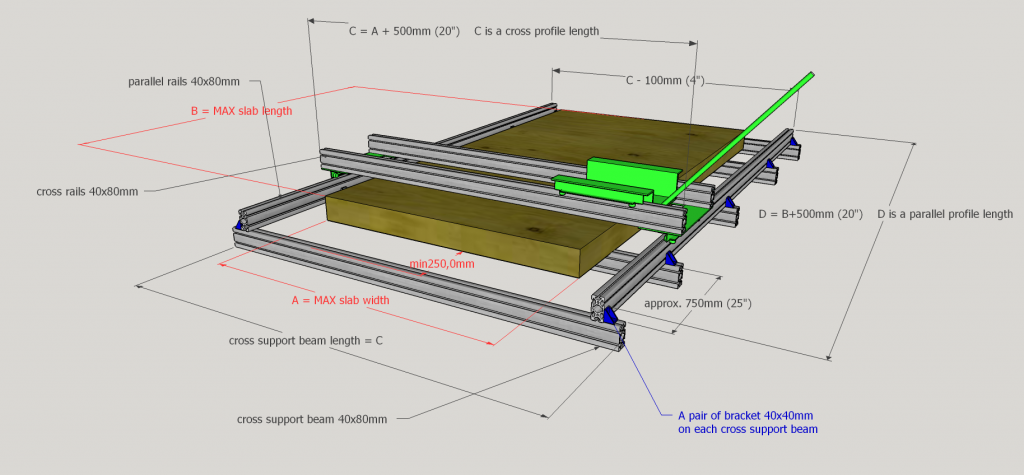
Where can I get the rails (aluminum profile) from?
UK
USA
Canada
Australia
In case you are from other country, email us and we help find you your local retailer.
Why should I build the router sled from expensive aluminum profiles?
Assembly and disassembly of this router sled is very easy and fast. Aluminum strut profiles allow fix the router cart in any position and make flattening faster, easier and more precise. Aluminum profiles are stable and has no tendencies to bend.